What are “mola”?
The mola forms part of the traditional costume of a Kuna (indigenous people of Panama) woman. Two mola panels make front and back panels in a blouse.
In the Kuna's native language, "mola" means "shirt" or "clothing". The mola originated with the tradition of Kuna women painting their bodies with geometrical designs, using available natural colors; in later years these same designs were woven in cotton, and later still, sewn using cloth bought from the European settlers of Panamá.
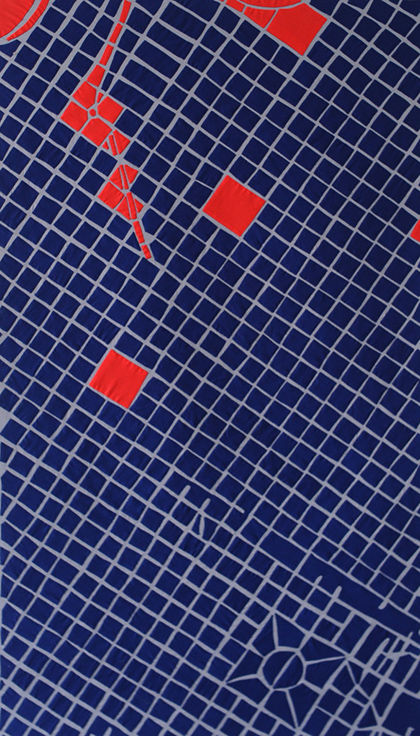
Molas are handmade using a reverse appliqué technique. Several layers (usually two to seven) of different-colored cloth (usually cotton) are sewn together; the design is then formed by cutting away parts of each layer. The edges of the layers are then turned under and sewn down. Often, the stitches are nearly invisible. This is achieved by using a thread the same color as the layer being sewn, sewing blind stitches, and sewing tiny stitches. The finest molas have extremely fine stitching, made using tiny needles.
Mira Valencia has been fascinated by the molas since her first time in Panama and during her years in Panama, she has been collecting quite a lot of the most creative and elaborated ones. In 2012 she decides to make a project of her own creating pieces that combine in some way the Kuna women work that would fascinated her. In 2013 -after one year making big format molas representing maps of cities around the world- Valencia presented a solo show called “Mola-Maps.”
Mola Maps
Layers, stitches, labyrinths
“In the layout of the streets each made the path of his persecution.”
Italo Calvino
The cities are replete of layers and labyrinths: constructions on destruction, memories and desires on realities, garbage on sidewalks, concrete on fields, graffiti on walls, skyscrapers on streets and underground, mistakes on success and success on mistakes… crannies, caches, avenues, dead ends, underworlds of splendor or depravation. Each of us lives in a different city, personal and invented. Through maps (another human invention that follows endless impositions and subjectivities, although it does not seem to), Mira Valencia takes us on a revealing journey to the cities that in one form or another have impacted her life.
Like the city, the mola is also made of layers, labyrinths and inventions. The Mola Maps, with their intricate semi-abstract compositions, were sewn by indigenous women from Guna Yala region (Panama) in their traditional technique, following the drawings and directions from the artist. It looks that Valencia has restricted the color range to highlight the stitches tensioning the layers of fabric, and with it, to stand out the beautiful and profoundly human imperfection of the molas. The fact that they were hand-made by women that have never set foot in the cities evoked by the maps they sew, makes even more complex the semantic density of these pieces that speak about the layers and the physical and emotional labyrinths in we all live.
Carolina Hausmann
Panama, October 2013